

This page contains our research methodology, including descriptions, justifications, and scoring for all criteria, how we derived these criteria, and our benchmark lifecycle model. Please reach out here in case you have any questions!

This section outlines the key criteria used in our evaluation process. Each criterion is expandable, providing detailed information about its importance and how it's assessed.
| Design |
|---|
|
Definition of tested capability or characteristic
Explanation: The benchmark developers mention and define what underlying capability or characteristic of a model is supposed to be tested with the benchmark. Justification: Defining the objective of the benchmark is necessary for clarity in its design. It also helps users determine if the benchmark aligns with their specific application needs and ensures that users and developers have a shared understanding of the concept being evaluated, facilitating consistent interpretation of results. Points:
|
|
Description of how tested capability or concept translates to benchmark task
Explanation: The benchmark developers describe how the tested capability or characteristic translates to the task implemented in the benchmark/the task the model is tested on in the benchmark. Justification: Clearly explaining this translation ensures that the benchmark tasks accurately reflect the intended tested capabilities and concepts, providing valid assessment results. Points:
|
|
Description of how knowing about the tested concept is helpful in the real world
Explanation: The developers describe why it is useful to know about the tested capability in the real world. Justification: This description helps users understand the practical value of the benchmark, demonstrating how the tested capability impacts real-world applications and use cases. Points:
|
|
Description of use cases and user personas for the benchmark
Explanation: A use case for an AI benchmark involves specifying a scenario in which the AI system will be evaluated. This scenario should include the cultural and geographic context and the type of interactions between humans and models, if applicable. Additionally, user personas should be defined to represent the different types of users that might interact with the AI system, if applicable. Justification: Use cases set the context and scope of the benchmark. User personas outline an understanding of the different types of interactions the benchmark developers anticipate the tested AI system to be used in, e.g., ranging from typical users to those with specific challenges or malicious intent. This approach ensures that the design of the benchmark is closely related to real-world applications and that it's effective across diverse scenarios. Points:
|
|
Involvement of domain experts
Explanation: Domain expert(s) who have a professional background or research experience in the concept to be tested are either co-authors of the paper, or were involved in the benchmark design process, i.e., the paper makes clear how they obtained the expertise and how that informed the benchmark design. Justification: Involving domain experts ensures that the benchmark design is informed by deep, specialized knowledge, increasing its validity and relevance. This expertise helps to create tasks that accurately assess the targeted capabilities and align with real-world scenarios. Points:
|
|
Integration of domain literature
Explanation: The developers cite domain literature in the background section and describe how insights from this literature informed the design of their benchmark or cite relevant domain literature in the benchmark design process. Justification: By consulting domain-specific literature, benchmark developers can ensure that the tasks and evaluation criteria they include are representative and aligned with the current state of knowledge in the field. This literature often contains valuable insights into best practices, established methodologies, and proven approaches for evaluating the tested concept, which can be incorporated into the benchmark design to enhance its reliability. Points:
|
|
Description of how benchmark score should or shouldn't be interpreted/used
Explanation: The benchmark developers provide information about what benchmark users can and cannot take away from the benchmark score. Justification: Clarifying the interpretation of benchmark scores prevents misuse and misinterpretation, ensuring that users draw accurate conclusions about a model's performance. This guidance helps users apply the scores appropriately within their specific contexts, and understand if the benchmark can be used to assess a model for their desired application context. Points:
|
|
Informed choice of performance metric(s)
Explanation: The developers describe how the performance metric for the defined benchmark task should be interpretable, meaningful, and standard for the task that's being evaluated. If a non-standard metric is selected, they describe their rationale for choosing a non-standard metric. Justification: The metric should be easily understood by the reader to build their own opinion about the model's capabilities, given the benchmark score. If a non-standard metric is used, an explanation is necessary to clarify its relevance and ensure that users can accurately interpret the results. Points:
|
|
Includes floors and ceilings for metric
Explanation: The benchmark provides clear floors and ceilings for the metric(s) it uses. Justification: Establishing clear floors and ceilings for metrics ensures that users have a reference point for understanding model performance. It helps users understand if a benchmark is already saturated or if progress can be made on the task. This also allows benchmark developers to decide when a benchmark should be retired. Points:
|
|
Includes human performance level
Explanation: The benchmark explicitly states human performance measured on the benchmark task. It also explains how human performance was measured and if this was the performance of an average or expert group of humans. The benchmark notes if measuring human performance is not possible on the benchmark task and why. Justification: Including human performance on a benchmark allows the reader to put the model's performance into perspective and allows for a better interpretability of the benchmarking score. Points:
|
|
Includes random performance level
Explanation: The developers explicitly states the random performance measured on the benchmark. Justification: By establishing a baseline performance level achieved through random guessing, generation, or selection, benchmark users can better understand the extent to which a model's performance stems from its inherent capabilities, rather than mere chance or the benchmark's design and especially metric choices. This random performance level serves as a reference point, allowing for a clearer assessment of the model's true effectiveness in tackling the specific task at hand. Points:
|
|
Addresses input sensitivity
Explanation: The benchmark contains multiple input variations with the same semantic meaning/intended to elicit the same response or output by the tested model. The developers describe all relevant details such as how many different variations were tested per prompt, and how the variations were designed. For language models, this would mean including a variety of semantically (but not syntactically) equivalent prompts to combat prompt sensitivity. For computer vision models, this could mean inputting a normal, a blurred, and a cropped version of the same image, etc.), while for reinforcement learning, this could mean measuring the sensitivity of learned policies to input features. Justification: Addressing input sensitivity in a benchmark ensures that the model's performance is consistent across semantically equivalent inputs, thus validating its robustness. Including multiple variations per input and detailing their design allows for inspection and replicable evaluation of the model's capabilities. This serves the goal of approximating intrinsic model capabilities or harms better rather than just measuring "an artifact" of your input. Points:
|
|
Validated automatic evaluation available
Explanation: Evaluating a model against a benchmark does not require human evaluation in the process and the quality of the automated evaluation is validated (if applicable, e.g., in the case of FM-based evaluations). Justification: Requiring human feedback to evaluate performance on a benchmark will significantly limit the scalability of the benchmark and potentially introduce biases from the human evaluators themselves. In addition, this may require an IRB for researchers, and will be more costly than an automatic evaluation, creating "major barriers to entry". Points:
|
|
Explanation of differences to related benchmarks
Explanation: The benchmark developers explain how their benchmark fills a gap compared to existing benchmarks or how it expands on existing benchmarks or their tested concepts. Justification: Benchmark developers demonstrate the added value and relevance of the new benchmark, justifying its necessity by addressing specific gaps in existing benchmarks or by expanding on saturated benchmarks. This allows users to better understand the differences between related benchmarks and determine which one to use for their specific evaluation context. Points:
|
| Implementation |
|
Availability of evaluation code
Explanation: The benchmark developers make the code available for others to evaluate their own models against the benchmark, e.g., as part of a GitHub repository. Justification: Without access to the benchmarking procedure itself, the benchmark cannot be scrutinized by external parties to verify its reliability and adequacy, nor can it be utilized for independent evaluations and comparisons by benchmark users. In addition, if benchmark users have to write their evaluation code from scratch, it's more likely that seemingly minor implementation details affect the measured performance, hindering a fair comparison. Points:
|
|
Script to replicate results is explicitly included
Explanation: The benchmark developers give access to the input, output, and evaluation code, as well as all other necessary information (e.g., hyperparameters or random seed set) that they used to create the initial benchmarking results presented in the paper. Justification: Providing access to the input, output, and code allows for transparency and reproducibility of the reported results, fostering trust into the benchmark, and contributing to overcome the current reproducibility crisis in AI/ML research. Points:
|
|
Accessibility of evaluation data, prompts, or dynamic environment
Explanation: The benchmark developers make the evaluation data, prompts, or the data/environment generation mechanism accessible. These do not have to be made public in order to earn full points (if contamination is a concern, for example), but some access to it for evaluation purposes, e.g., by hosting it privately on Hugging Face, needs to be possible. Justification: Without any accessibility of the evaluation data, prompts, or environment generation mechanism, a benchmark cannot be used. Points:
|
|
Supports evaluation of models via API calls
Explanation: The benchmark developers allow the benchmark evaluation of models via API access, if applicable. Justification: This criteria is dependent on the subfield. In NLP, for example, closed-source models such as GPT-4 are oftentimes only accessible via API. Without support for API evaluation, they cannot be evaluated, which is especially problematic if such models are the state-of-the-art models in the field. Points:
|
|
Supports evaluation of local models
Explanation: The benchmark developers implement code to support the evaluation of local models without API access. Justification: Some model developers only host their models locally. A benchmark should support the evaluation of those to allow for a wide variety of models to be evaluated against the benchmark. Points:
|
|
Inclusion of a globally unique identifier or encryption of evaluation instances
Explanation: Benchmark developers include a globally unique identifier (GUID) or canary string in the main public evaluation code and all public evaluation prompt or data files. Alternatively, they encrypt the test data files and make the key public. Justification: Including a GUID in relevant (sub-)repositories, public code and data repositories can support the identification of data contamination in models, either by allowing model developers to filter out the evaluation data out of large amounts of web-scraped data or by allowing benchmark developers to identify which model developers trained on their data and hence have created models that potentially perform better than they should on the benchmark. Encrypted test data files prevent non-adversarial crawling of such data; however, some advise against "using standard obfuscation or compression methods that are not key-protected, since some crawling systems include pipelines of automatic decompression or deobfuscation." Points:
|
|
Inclusion of 'training_on_test_set' task
Explanation: The benchmark includes a task to identify if the model was trained on the benchmark data. Justification: Public benchmarks face the challenges that their evaluation data may be web-scraped and used to train a model. A 'training_on_test_set' task can serve as a "post-hoc diagnosis of whether [...benchmark] data was used in model training." Points:
|
|
Assess need for warnings for sensitive/harmful content
Explanation: Benchmark developers explicitly mention in the paper if the evaluation tasks or the expected output may contain sensitive or harmful content. If they do not anticipate sensitive/harmful content in either case, they should explicitly state that. Justification: By explicitly stating the presence of sensitive or harmful content and issuing appropriate warnings, developers help users make informed decisions and take necessary precautions. Even if developers do not expect sensitive or harmful content, if they state that, they showcase to the benchmark users that they actually thought about the possibility. Otherwise, users couldn't be sure if the input or output doesn't contain problematic content or if the developers just forgot to include a warning. Points:
|
|
Release requirements specified
Explanation: Benchmark developers specify rules for benchmark users to "ensure the integrity of test results". While not all benchmark developers will be able to enforce the release requirements, they should at least specify them. One example is: "1. Publishers do not train directly on or against the benchmark dataset and retract any reported results if and when benchmark data is found to have been in training data. 2. Techniques that are likely to increase the test performance without a commensurate increase in safety factor are discouraged and may result in benchmark exclusion. [...]" Justification: Written terms of use can help to set expectations and have a foundation to address subsequent contamination or intentional gamification attempts of the benchmark. Potential options they could mention in case of release requirement breaches are, e.g., "publishing public statements correcting the public record" or "resulting in the [model] being permanently banned from the benchmark"; however, we will not assess the enforcement ability or potential listed sanctions as part of this criteria, just the statement of release requirements. Points:
|
|
Includes build status or equivalent
Explanation: A build status is a feature, typically implemented as a GitHub Action, that indicates whether the most recent build of the benchmark was successful. It should be implemented for the benchmark's evaluation code. It verifies that the code is running correctly after the latest commit. Justification: A passing build status signifies that the main evaluation code was usable at the latest commit. Including a build status or equivalent can help to ensure the reliability and usability of the evaluation code. It allows benchmark users to quickly determine if the code is functioning as intended, saving time and effort in identifying potential issues. Points:
|
| Documentation |
|
Requirements file available
Explanation: A requirements or environment file, or equivalent is available. Justification: Ease of use is a key criteria for benchmark adoption. Providing a requirements file allows for the quick installation of relevant packages at the correct versions, e.g., within a virtual environment, to use the evaluation code. Points:
|
|
Quick-start guide or demo code available
Explanation: The benchmark developers make a quick start guide or demo available that walks step-by-step through how the benchmark can be used. Justification: Similar to the criteria above, ease of use is a key criteria for benchmark adoption. Providing a quick-start guide takes away any guesswork on the user side and allows them to directly set up and use the benchmark without spending extra time on setup issues. Points:
|
|
Includes informative In-line code comments
Explanation: In-line code comments state the purpose, inputs, outputs, and functionality of each code segment in all files relevant for the benchmark evaluation. Justification: In-line documentation of code enhances clarity, understanding, and reproducibility. It facilitates collaboration, maintainability, and makes debugging easier for benchmark developers and users, should that be necessary. Points:
|
|
Code documentation available
Explanation: A full documentation of the repository and code it entails is publicly available. This includes, for example, an overview of the folder structure, the files in the repo, an explanation of functions in the repo. Justification: Detailed documentation of code enhances clarity, understanding, and reproducibility. It facilitates collaboration, maintainability, and makes debugging easier for benchmark developers and users, should that be necessary. Points:
|
|
Documentation of test task categories & rationale
Explanation: The benchmark developers define the tasks or task categories a model is tested on and describe the rationale for choosing the tasks or task categories. The rationale should explain how these tasks are relevant to the benchmark's objectives, what they aim to measure, and why they are important for evaluating the concept or capability to be tested. Justification: Documenting test tasks is essential for transparency and for allowing public scrutiny of the benchmark. The rationale provides insight into the selection process, demonstrating that the tasks are not arbitrary but are carefully chosen to reflect real-world applications and user needs. Both help users decide if the benchmark is adequate for their evaluation contexts. Points:
|
|
Documentation of assumptions about normative properties
Explanation: If the benchmark measures properties that vary across cultural contexts (e.g., politeness), then normative assumptions are explicitly stated. The benchmark developers clearly define the cultural context and values that the benchmark adheres to, explaining how the measured properties are conceptualized and operationalized within the benchmark. Justification: By explicitly stating normative assumptions, the authors provide transparency about the cultural framework and values that guide the benchmark's design and evaluation criteria, which can subsequently ensure cultural sensitivity and mitigate potential biases. It also facilitates informed decision-making for users of benchmarks, specifically for culture-dependent use cases they're interested in, such as measuring toxicity or bias, for example. Points:
|
|
Documentation of limitations
Explanation: Benchmark developers outline the limitations of the benchmark, including but not limited to the tasks, contexts, and scenarios that are not covered by the evaluation are acknowledged. It's stated which use cases are out-of-scope. Justification: Documenting a benchmark's limitations is necessary for users to assess its suitability for their specific evaluation needs. By understanding what the benchmark does not cover, users can make informed decisions about whether the benchmark aligns with their goals and whether additional evaluations (either in the form of other benchmarks or private evaluations) may be required to complement the benchmark's results. Points:
|
|
Documentation of benchmark construction process
Explanation: Benchmark developers give a detailed account of the design process, including the specific decisions made at each life-cycle stage, the rationale behind them, and any trade-offs or compromises (e.g., balancing complexity vs. practicality) considered. Justification: Documenting the benchmark design process is essential for transparency, as it allows users to understand how the benchmark was created and what factors influenced its development. It allows users to assess the thoroughness and rigor of the benchmark's construction. This information further enables users to critically evaluate whether the benchmark is suitable for their specific use case. Points:
|
|
Documentation of data collection or environment/prompt design process
Explanation: A detailed description of the data collection process, including the sources of the data, the criteria for selection, and any preprocessing steps is provided. For benchmarks involving prompts, a description of how the prompts were created, how they were validated, and why they were used to elicit the desired responses was included. For benchmarks involving dynamic environments or test data, the design specifics and templates for the dynamic process were explicitly described. Justification: Documenting the data collection or prompt design process is important for ensuring the transparency, reproducibility, and validity of the benchmark. By providing a clear and detailed account of how the data was collected or how the prompts were designed, users can assess the quality and representativeness of the benchmark's data, identify potential biases or limitations, and determine whether the data or prompts are suitable for their specific use case. Points:
|
|
Documentation of evaluation metric(s)
Explanation: The evaluation metrics used are clearly specified and defined, both for standard and custom metrics tailored to the specific task or domain. The exact formulas or processes used to calculate these metrics, along with any parameters or thresholds employed, are made transparent. Justification: Documenting the evaluation metrics and scoring process is essential for enabling users to understand how the benchmark quantifies model performance and determines rankings or comparisons. By providing clear and detailed information about the metrics and scoring methods, users can assess whether the chosen metrics are appropriate for the task at hand, align with their own evaluation criteria, and provide a fair and meaningful basis for comparing different models or approaches. Points:
|
|
Report statistical significance of benchmark results for at least one model
Explanation: Benchmark developers run statistical significance tests on the benchmark results. They report results for, e.g., more than one random seed, and provide variance bounds. In cases where the benchmark is perfectly deterministic, this should be explicitly stated. Justification: Not doing statistical significance testing can significantly reduce the validity, utility and confidence in results. Especially for benchmarks, we want to understand how much of the results are due to noise and how much is caused by true differences between the models tested. Points:
|
|
Accepted at peer-reviewed venue
Explanation: The benchmark/its associated paper was accepted to a peer-reviewed journal, conference, or similar venue. Justification: Acceptance at a peer-reviewed venue signifies that the benchmark has undergone an evaluation by an external party, ensuring its validity, reliability, and scientific merit. This peer review process contributes to the credibility and assurance to users that the benchmark meets established standards of quality and relevance. Points:
|
|
Specifies applicable license
Explanation: The benchmark developers clearly specify the applicable license for the benchmark in the code repository or paper. This includes providing information about the conditions under which the benchmark can be used, modified, and distributed. Justification: Specifying the applicable license ensures legal clarity and compliance for benchmark users and enables wider adoption, as commercial users might not be able to use the benchmark if no license is specified. Points:
|
|
Provision of a globally unique, persistent identifier for a dataset and its metadata
Explanation: The benchmark dataset and its associated metadata are assigned a globally unique and persistent identifier, such as a Digital Object Identifier (DOI), to ensure long-term accessibility and citability of the resource (FAIR Principles, 2024). Justification: A persistent identifier supports the findability and accessibility of the benchmark and its dataset. It allows for unambiguous referencing of the data, facilitates proper attribution, and ensures that the dataset can be located and accessed over time, even if its physical location changes. This practice aligns with the FAIR (Findable, Accessible, Interoperable, Reusable) principles, enhancing the benchmark's scientific value and reusability. Points:
|
|
Inclusion of standardized metadata (e.g., following the Croissant standard)
Explanation: The benchmark includes comprehensive, standardized metadata that describes the dataset, its structure, and relevant information about its creation and usage. This metadata adheres to established standards such as the Croissant standard, which is designed specifically for machine learning datasets. Justification: Standardized metadata is crucial for ensuring interoperability and reusability of the benchmark dataset. It provides consistent and machine-readable information about the dataset's contents, structure, and provenance. This standardization facilitates easier discovery, understanding, and integration of the dataset into various research workflows. By following established standards like Croissant, the benchmark enhances its utility across different platforms and tools in the machine learning ecosystem. Points:
|
|
Documentation of data sources and how the data was collected (if applicable)
Explanation: The benchmark provides comprehensive documentation detailing the origins of the data, the methods used for data collection, and, where applicable, discusses issues of data provenance and informed consent. They also list the license types for all data used and how they ensured compliance with that license. Justification: Thorough documentation of data sources and collection methods is necessary for ensuring transparency, reproducibility, and ethical design of the benchmark. It allows users to understand the context and limitations of the data, assess its appropriateness for their specific use cases, and make informed decisions about its application. Furthermore, discussing data provenance and informed consent addresses ethical considerations, particularly when dealing with sensitive or personal data, and helps ensure compliance with data protection regulations. Points:
|
|
Documentation of the data preprocessing steps taken
Explanation: The benchmark provides a detailed account of all preprocessing steps applied to the raw data before its inclusion in the final dataset. This documentation includes information on data cleaning, normalization, feature engineering, handling of missing values, and any other transformations or manipulations performed on the original data. If no data preprocessing was done, the authors state this explicitly. Justification: Thorough documentation of preprocessing steps is necessary for ensuring reproducibility and transparency of the benchmark. It allows users to understand exactly how the final dataset was created, which is key for interpreting results, replicating experiments, and assessing the benchmark's applicability to different use cases. Additionally, this information helps identify potential biases or artifacts introduced during preprocessing that could affect model performance or generalization. Points:
|
|
Documentation of the data annotation process (if applicable)
Explanation: The benchmark provides documentation of the data annotation process, including the annotation guidelines, the qualifications and training of annotators, the annotation tools used, quality control measures, and inter-annotator agreement metrics. This documentation covers the entire workflow from raw data to the final annotated dataset. Justification: Comprehensive documentation of the annotation process is necessary for understanding the quality, reliability, and potential biases in the labeled data. It allows users to assess the suitability of the dataset for their specific tasks and to interpret results accurately. Transparent annotation documentation also enables reproducibility of the labeling process, facilitates improvements in future iterations of the benchmark, and helps in identifying and mitigating potential sources of bias or error in the annotations. Points:
|
|
Documentation of the representativeness of the data (if applicable)
Explanation: The benchmark provides analysis and documentation of how representative the dataset or environment is of the target population or domain. This includes an explanation of the sampling procedure used, any potential biases in the data collection process, and how well the dataset captures the diversity and distribution of the intended population or phenomenon being studied. Justification: Understanding the representativeness of the data is necessary for assessing the generalizability and validity of any conclusions drawn from models trained or evaluated on the benchmark. It helps users identify potential limitations or biases in the dataset that could affect model performance in real-world applications. Proper documentation of representativeness also aids in interpreting benchmark results within the context of the population it represents and highlights areas where the dataset may need expansion or improvement to better cover underrepresented groups or scenarios. Points:
|
|
Standardized documentation
Explanation: The benchmark utilizes a standardized documentation format, such as data cards, to present the information about the dataset that is underlying to the benchmark. This standardized approach ensures that all key aspects of the dataset are systematically covered, including its composition, collection methodology, intended uses, ethical considerations, and potential biases. Justification: Adopting a standardized documentation scheme like data cards enhances the usability and transparency of the benchmark. It provides a consistent, structured format that makes it easier for users to quickly understand the dataset's characteristics, limitations, and appropriate use cases. Standardized documentation facilitates easier comparison between datasets and benchmarks, promotes best practices in data reporting, and helps identify potential issues or gaps in the dataset's coverage. Points:
|
| Maintenance |
|
Code usability checked within the last year
Explanation: The main files of the public code were updated within the last year, or the developers checked that the benchmark code is still usable and explicitly state this check in the README file, including the date of the check. Justification: Over time, packages that the benchmark depends on may be updated and become incompatible with the original evaluation/benchmark code. To ensure ongoing usability, benchmark developers must check if their code can still be used at least once a year. This practice ensures that users can use the benchmark without encountering and having to fix issues due to outdated dependencies. Points:
|
|
Maintained feedback channel for users
Explanation: GitHub issues are acknowledged or addressed within three months. If there are no open issues, benchmark developers would get full points. Justification: Over time, users may find issues with the benchmark tasks or implementation. To ensure continued usability, benchmark developers should address these concerns in a reasonable amount of time. Promptly responding to user feedback helps maintain the reliability and relevance of the benchmark. Points:
|
|
Provide contact details of person responsible for benchmark
Explanation: The benchmark should include contact details of the person responsible, such as a corresponding author in the associated paper, a contact person listed on GitHub or the website, or an available online feedback form. Justification: Providing contact details ensures that users have a communication channel for inquiries, feedback, or reporting issues related to the benchmark. This transparency supports effective collaboration and resolution of problems, enhancing the benchmark's usability. Points:
|
This section outlines the key criteria used in our evaluation process. Each criterion is expandable, providing detailed information about its importance and how it's assessed.
Step 1: Mapping the space. Initially, we surveyed the existing benchmark landscape (see Section: Related Work). Based on this review, we identified five stakeholder groups who present the user personas of our assessment (see Section: Stakeholders). To understand their objectives w.r.t. benchmarking, we conducted unstructured interviews with representatives of all stakeholder groups, including 20+ policymakers, model developers, benchmark developers, model users, and AI researchers. During this process, we developed a five-stage model of the benchmark life cycle (see Figure: Lifecycle and Section: Lifecycle) and mapped both the benchmarking objectives of the stakeholders and their communicated use cases for a benchmark assessment (see Section: Stakeholders).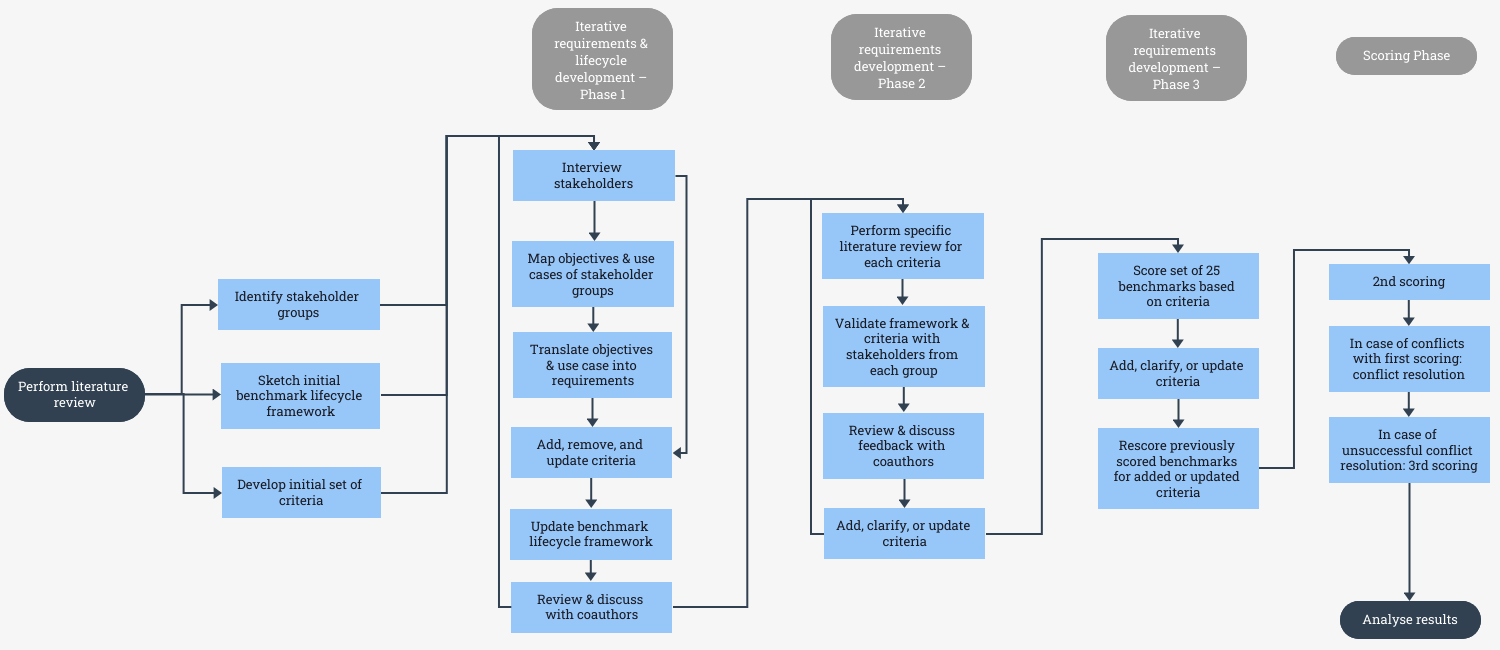
Step 2: Translation to criteria. Based on Step 1, we identified tasks and objectives for each stage of our benchmark life cycle and translated them into concrete criteria. We categorized these as:
The assessment is limited to category (a) criteria. We cover criteria in (b) in the section "Other Considerations" in our paper, and those in (c) in "Open Challenges" in our paper.
Step 3: Validating the assessment. Initially, three authors independently scored the same benchmark to calibrate the assessment and identify potential misinterpretations of the criteria. We adapted and clarified scoring guidelines to address differing interpretations and uncertainties. To validate our assessment, we shared it with members of all stakeholder groups and revised it based on their feedback. Finally, we verified that our assessment, which in itself is a benchmark, met all of our defined criteria, where applicable (the result of this assessment can be found in Appendix: Example Checklist).
Step 4: Structuring the assessment. We evaluated 16 foundation-model and 9 non foundation-model benchmarks. We prioritized commonly used benchmarks, such as those that were recently reported by model developers [1, 2] and aim to expand the number of assessed benchmarks continuously on our website. Since our assessment considers varying information sources (official websites, papers, GitHub repositories published by the benchmark developers1) that do not follow a standard structure, we manually evaluate all benchmarks. At least two authors independently reviewed each benchmark. They subsequently had to reach a consensus on the final score and a third reviewer could be called to make the final decision if a consensus could not be reached (This case did not occur).
Step 5: Scoring. We scored benchmarks on discrete 0/5/10/15 point scale for each criterion: 15 for fully meeting, 10 for partially meeting, 5 for mentioning without fulfilling, and 0 for neither referencing nor satisfying the criterion. Average scores were calculated for each benchmark life cycle stage (design, implementation, documentation, and maintenance). An aggregate usability score, representing the weighted average of the implementation, documentation, and maintenance scores, was also introduced (see Section: Scoring for scoring details). We consider an average score of 10 or higher to indicate a reasonably good benchmark for each aggregated scoring category, as it signifies that the benchmark at least partially fulfills all assessment criteria within the respective category.
Step 6: Platform for continuous updates. Finally, we develop this website to continuously publish assessment results using the scoring methodology in Section: Scoring, given the rapid development of new benchmarks. The website includes a community feedback channel for submitting new AI benchmarks and correcting previously posted scores if benchmarks are updated or stakeholders disagree with our evaluation. This provides benchmark users with an accessible, up-to-date database of existing benchmarks and their quality, enabling quick analysis of the most suitable benchmark for their application context.
In this section, we're describing the benchmark lifecycle model we've derived from steps 1 and 2 above. You can also find a visual overview in Fig. 1.
During the design stage, a benchmark's purpose, scope, and structure are defined. This requires developers to identify key aspects of an AI system that the benchmark will assess. Based on this decision, they must determine the tasks, datasets, and evaluation metrics which will be used in their benchmark. To inform these decisions, developers consider the requirements of potential users and stakeholders, possibly collaborating with and gathering feedback from these stakeholders.
At this stage, the benchmark is constructed and all necessary components are aggregated. Developers collect, process, and (if applicable) annotate the datasets to be used for their tasks. They then create the evaluation scripts and scoring mechanisms which allow models' performance on this data to be measured. So that new models can be evaluated, developers may implement user interfaces and APIs which enable access to and interaction with the benchmark. This stage concludes with the initial testing and validation of benchmark components.
To facilitate the benchmark's use and interpretation, benchmark developers need to create comprehensive documentation. This includes preparing detailed descriptions of benchmark tasks, datasets, and evaluation metrics. Additionally, developers may provide instructions for how to access, use, and submit to the benchmark. Documenting design decisions, limitations, and potential biases enables stakeholders to make informed decisions regarding benchmark use. Creating resources for running the benchmark, such as quick-start guides, code documentation, and examples or tutorials is an essential step for accessibility.
Once the benchmark and its documentation are released, developers must conduct regular maintenance to ensure ongoing usability. They may monitor benchmark usage and performance to identify areas for improvement and track users' compliance with release requirements. Other tasks at this stage include addressing issues or bugs and incorporating user feedback into updates. Developers can regularly update documentation and support materials. Additionally, they can assess the continued relevance and utility of the benchmark by monitoring performance on the benchmark and responding to community feedback.
The final phase of a benchmark's life cycle is retirement. Benchmarks are phased out or replaced when they become saturated (i.e. model performance reaches the benchmark metric's ceiling), the task studied loses relevance, or better alternatives emerge. During retirement, developers communicate their plan to stakeholders and can provide guidance on transitioning to alternatives. They archive benchmark data, code, and documentation. As a benchmark is retired, developers may share insights gained with the AI community. Finally, they should clearly mark the benchmark as "retired" on channels for deployment and platforms publishing its results.
As with every research project, a lot of time and passion were put into this initiative. If you found our work useful, we’d appreciate it if you’d cite us. Some standard citations can be found below:
@inproceedings{reuel2024betterbench,
              title={BetterBench: Assessing AI Benchmarks, Uncovering Issues, and Establishing Best Practices},
              author={Reuel, Anka and Hardy, Amelia and Smith, Chandler and Lamparth, Max and Hardy, Malcolm and Kochenderfer, Mykel J.},
              booktitle={Advances in Neural Information Processing Systems (NeurIPS)},
              url = {https://betterbench.stanford.edu},
              year = {2024}
            }